
What poet, hearing the poems Sur has made, will not nod his head in pleasure?” asks 17th-century saint Nabhadas in Shribhaktamal, one of the oldest Indian vernacular hagiographies. This is bhakti scholar John Stratton Hawley’s translation of the opening line on Surdas, expressing appreciation for the saint’s poetic brilliance that is shared by countless devotees worldwide.
Surdas is a mainstay in the family of North Indian bhakti saints. Primarily a saguna poet, he composed in Brajbhasha for and about a personal God with personality traits (saguna: sa “with,” guna “attributes”). To Surdas, Divinity came in the form of Shri Krishna, the eighth avatar of Vishnu. Surdas also wrote about Lord Rama and Sita, and often addressed Hari; but he is most celebrated for his songs on Krishna leela (“divine play”).
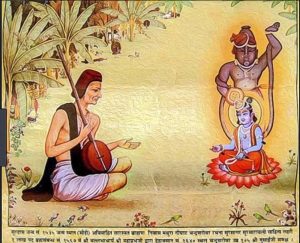
Surdas is remembered as a blind poet-saint in the Braj region south of Delhi, where Lord Krishna spent his childhood. There are many explanations for Sur’s loss of sight, ranging from blindness from birth, to metaphorical blindness, to his request to Krishna to remove his vision after a magnificent darshan of the Lord. Devotees consider his blindness an advantage, as worldly distractions would not affect his spiritual vision. The songster was renowned in his own times in the 16th century. Stories include his being invited to compose for Mughal emperor Akbar, who greatly admired his poetry. Nabhadas, who composed his influential Shribhaktamal in the early 1600s, devoted several lines praising Surdas’s matchless lyrical dexterity in conveying the depths of devotion. Since then, Surdas has remained renowned among Vaishnava poets, revered by worshipers and scholars alike.
Surdas is the most well known of the ashtachaap, “eight seals,” or eight great disciples, of the Vallabha Sampradaya, also known as Pushtimarga. Founded by Vaishnava philosopher-theologian Vallabhacharya (c. 1475–1530), this devotional community engages in pure nondualism (Shuddha Advaita) through Krishna-centric worship. One of Vallabhacharya’s grandsons, Gokulnath, compiled the Chaurasi Vaishnavan ki Varta (Accounts of Eighty-Four Vaishnavas) in the 17th century. The work features Surdas as a principal teacher in the tradition and contains an account of his life, with Vallabhacharya as his spiritual mentor.
Sur’s Ocean of Poems
The massive poetic corpus Sursagar (“Sur’s Ocean”) recounts numerous episodes from the tenth canto of the Sanskrit Bhagavata Purana in literary Brajbhasha dialect. According to the Vallabha Sampradaya, Surdas composed 125,000 poems, some of which are in the Sursagar, with others having been lost over time. Historians date the earliest manuscript of Sur’s poems at 1582, with 239 poems, from Fatehpur in present-day Rajasthan. By 1640, Sur’s collection of poems was termed Sursagar and contained 795 poems. That number steadily increased in later manuscripts, with a 19th-century Sursagar containing nearly ten thousand. Academicians conclude that poets over the centuries adopted Surdas’s voice and wrote poems in his name, even including his signature (chaap). Some poems in the Sursagar are about him; others simply embody his inspiring devotion. Surdas’s authorial identity extends thus beyond his lifetime, and the Sursagar now refers to the collective poems of the evolving Sur genre. As devotees, we can ask ourselves: If a poem can evoke bhakti in our hearts and minds, how much does history’s academic stamp of approval on the poet’s identity really matter?
Themes Surdas Loved
Surdas’s poems are lyrically par excellence, replete with visual detail describing darling Krishna’s divine deeds, virtues and form, often as elaborated in the Bhagavata Purana, using such terms as “dark one” and “Nanda’s delight” for Krishna. These are not mere creative descriptions but translations of affectionate addresses traditionally associated with the Lord.
Typical of bhakti poetry, Surdas’s poems emphasize personal experience and emotional engagement in relational terms, such as maternal affection (vatsalya bhava) for baby Krishna, or lovers’ honeyed emotions (madhurya bhava). The language frequently demonstrates viraha vedana, the longing and agony of separation from the divine beloved Hari. Surdas assumes the persona of a devotee, male or female, and at times even that of Lord Krishna. The gopis (cowherding women) whose ultimate goal is spiritual union with Krishna, epitomize viraha.
Surdas is also famous for bhramargit, “songs to the bee,” a type of viraha poem that the gopis of Braj sing to Krishna’s messenger Udho. While Udho consoles and philosophically reasons that Krishna exists within them as Supreme Being of the nirguna persuasion, the gopis respond by lauding the greatness of devotion to Lord Krishna with personality traits. Not surprisingly, a major theme in Surdas’s poetry is humble supplication, vinaya poetry that demonstrates a devotee’s laments and complaints of having been deserted or ignored by their Lord. The Sur genre continues to evolve today as artists and devotees recreate and relive his poems in temples, homes and concert halls worldwide
Surdas’s Poems
translated by john stratton hawley
A Bhramargit from 1582 in Fatehpur
Having seen Hari’s face, our eyes are opened wide.
Forgetting to blink, our pupils are naked
like those who are clad with the sky.
They’ve shaved their Brahmin braids—their in-laws’ teachings,
burned up the sacred thread of decorum,
And left their veils—their homes—to mumble exposed
through the forests, day and night, down the roads
In simple concentration—their ascetic’s death;
beauty makes them vow their eyes will never waver,
And anyone who tries to hinder them—husbands,
cousins, fathers—fails.
So Udho, though your words touch our hearts
and we understand them all, says Sur,
What are we to do? Our eyes are fixed.
They refuse to be moved by what we say.
χ χ χ
Ever since your name has entered Hari’s ear
It’s been “Radha, O Radha,” an infinite mantra,
a formula chanted to a secret string of beads.
Nightly he sits by the Jumna, in a grove
far from his friends and his happiness and home.
He yearns for you. He has turned into a yogi:
constantly wakeful, whatever the hour.
Sometimes he spreads himself a bed of tender leaves;
sometimes he recites your treasurehouse of fames;
Sometimes he pledges silence; he closes his eyes
and meditates on every pleasure of your frame—
His eyes the invocation, his heart the oblation,
his mutterings the food to feed
the priests who tend the fire.
So has Syam’s whole body wasted away.
Says Sur, let him see you. Fulfill his desire.